
The Making of the Hexagrams
I ChingThis flow traces the book's competing accounts of how simple line forms become trigrams and then sixty-four hexagrams.
increasing Bearing strength in each event
 decreasing
Bearing strength in each eventdecreasingNature as First Model
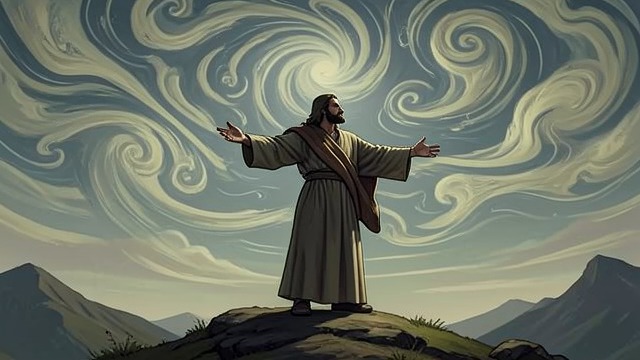
Looking Up and Down
A traditional origin story
The Great Treatise says that Fuxi surveyed the sky, earth, animals, and human life before devising the Eight Trigrams.
The account presents the diagrams as a response to patterns everywhere in nature. It gives them a sage's origin and an expansive purpose.
Legge's reservation
Legge reports the tradition but finds its explanation vague. It tells readers what Fuxi observed without showing precisely how observation generated the marks.
His treatment preserves the story as evidence of later belief, while resisting the claim that it proves the diagrams' actual origin.
Two Lines, Many Forms
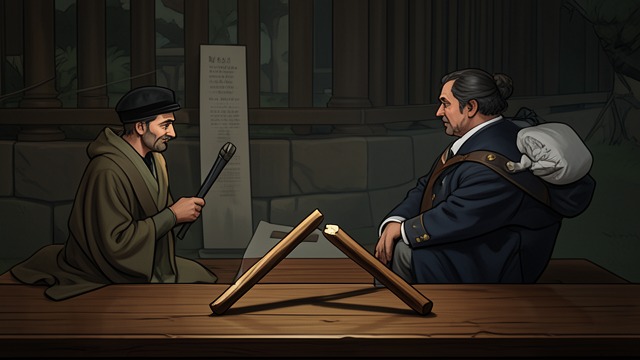
A Combinatorial Account
The elementary forms
A whole line and a divided line form the two basic marks. Repeated combination yields four emblematic figures, then the Eight Trigrams.
Adding lines successively produces figures of four, five, and six lines, culminating in sixty-four hexagrams.
An ordinary procedure
Legge argues that the process requires no extraordinary power. It is a simple method of combination, even if the tradition surrounds it with claims of ancient wisdom.
This account supplies a practical alternative to supernatural origin stories while leaving the diagrams' cultural significance intact.
The Great Ultimate Appears
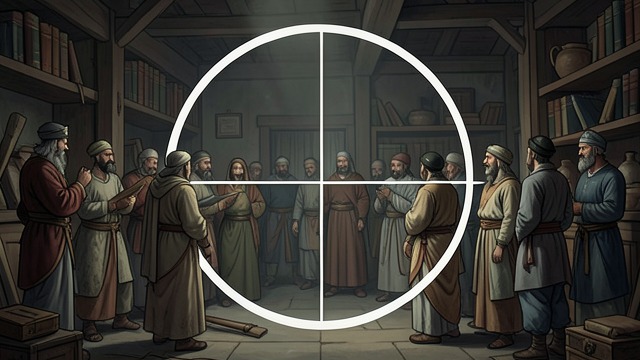
A Philosophical Origin
The sequence of generation
An appendix declares that the Great Ultimate produces the Two Forms, which produce the Four Emblematic Symbols and then the trigrams.
The formula turns a procedure for combining lines into an account of cosmic generation.
Legge questions the diagram
Legge notes that the Great Ultimate is not found elsewhere in the older Confucian literature. He associates the concept with later philosophical influence and challenges the circle used to represent it.
His criticism marks a boundary between the mechanics of the figures and the metaphysical explanation subsequently attached to them.
River Signs Enter the Story
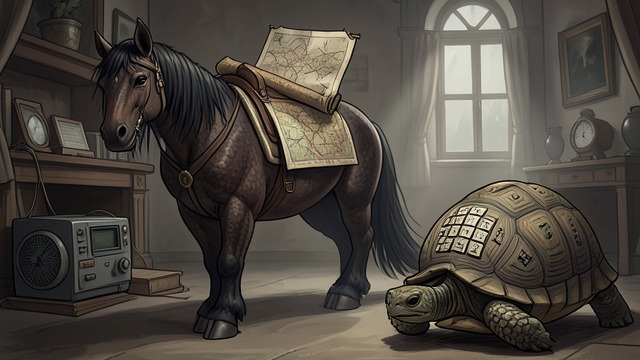
Maps from the Rivers
A sacred diagram
Tradition says the Yellow River produced a map borne by a dragon-horse, while the Luo produced a writing on a tortoise. The signs were said to guide sages in forming diagrams and ordering the world.
Legge sets out these stories because later explanations use them to account for the diagram system.
From legend to arithmetic
He compares the accepted River Map to a numerical arrangement and the Luo writing to a familiar magic square.
The comparison lowers the supernatural temperature of the story, suggesting that symbolic schemes may have gained sacred force from ordinary patterns.
The Figures Become a Method
A Usable System
From trigrams to hexagrams
The Eight Trigrams are combined into sixty-four figures, each with its own name and textual interpretation. The resulting system can support both reading and divination.
Legge considers the process practical rather than mysterious: repeated pairing of two line types produces a finite set of forms.
A limit imposed by use
The tradition stops at sixty-four figures. Legge suggests that the unwieldiness of larger systems offers a more likely explanation than a hidden cosmic prohibition.
The account ends with a human-scale technology: simple marks become a sophisticated interpretive instrument through convention and repeated use.
Antiquity, as described in the Great Treatise
At the conceptual beginning of the diagram system
After the early formation of the diagrams
A later legendary account of the diagrams
By the time divination is organized around the hexagrams
